Showing posts with label Marsascala. Show all posts

Thursday, July 29, 2010

Abandoned Hotel

What is it about abandoned buildings that’s so alluring? What causes us to be fascinated by the forgotten ruins of structures that once teemed with life? There is something so intriguing and mysterious and beautiful about abandoned and decaying old buildings. It may have something to do with the original purpose of those buildings. Homes and towns where families once lived are fascinating, but there’s something tragic and amazing about hospitals, churches, hotels and castles. These places were often the setting of life-changing experiences. When they’re abandoned and left to return to dust, we can’t help but imagine what used to take place within those walls.
The destruction of the inside makes the building strangely peaceful while reminding us that, without human intervention, our man-made structures are quickly taken down by nature and by time. The ex-Corynthia Jerma Palace Hotel in Marsascala is one such example. This four-star Hotel used to be Malta's most prestigious hotel in the south. It closed down in March 2007 after 25 years in operation, owned by Libyan Arab Foreign Investment Company, which also owned the land, and operated by the Corinthia Group.
The forces of erosion have dilapidated the building. The hotel was built on a peninsula facing the raging Majjistral and Scirocco winds and the sea, the wind and nature reduced this once splendid hotel into a heap of ruins inhabited by a massive colony of rats, mice and other infected insects. Other areas have been burnt down.

Palm trees, yucca and bougainvillea plants still thrive despairingly in this once-desirable place. The empty pools echo the happy cries of children of ages gone by. Stray cats roam the abondoned verandah in search of some shade from the relentless sun. Teenagers lurk in the darkest corners. Lovers hide in discreet places. Drug users leave their syringes lying about and now it seems that illegal immigrants are squatting on the site. This is what's left of the only hotel in the Southern part of our island. Such a pity...


Friday, July 2, 2010

St Thomas Bay in Marsascala

In the outskirts of Marsascala, one finds a large, natural inlet with small sandy banks and shallow water suitable for bathing. This is St Thomas Bay, known as 'Ir-Ramla' to the locals. St.Thomas Bay is on the outskirts of Marsascala. In fact it's very close to the village of Zejtun.


The bay is very large; however it only has a small sandy beach. Cliffs surround the majority of the bay. Its shallow waters and small sandy banks make the bay suitable for bathing especially for children. It is also popular with local holidaymakers. The bay is ideal for windsurfing. Now with the official opening of the new bypass Marsascala has become more accessible to all.

There are some cafes and snack-bars beside the bay. The bay is used also by many Maltese fishermen.

Friday, May 28, 2010

The Past and the Present

Mellieha

Here are 3 sets of photos, the past and the present. In the first one, one can see the Mellieha Parish church in the background. Now that I placed mine right under it I realised that I took the wrong angle of the church but it's definitely the same church.

The area beneath the church seems more or less the same.


Pretty Bay

I'm not sure which area of Pretty Bay this was but last summer I took one just for comparison.


Marsascala

I think this old photo, which was taken in 1885, was shot on the hill where the present church stands. I tried to take the same angle but couldn't since the church building is in the way. The last house on the right in the old photo can still be seen in my photo - it's the house behind the red kiosk.

Tuesday, July 14, 2009

Fishing...


Last week, I accompanied my husband on one of his fishing stints. This is quite a recent hobby of his and although I've been encouraged quite a number of times to join in the fishing I have not yet changed my mind. I don't like sitting down staring at the sea, doing nothing - that's what I usually answer back when people ask me why I don't go fishing too. But last week I must have been in need of some quiet time by the sea as I did not seem to mind sitting down and observing what was going on at sea. I didn't even bring a book with me as the sun had already set by the time we had settled down. For once I didn't lose my patience doing nothing. I felt a sense of calmness surrounding me.

There were so much going on around us that I had no time to get bored. From where I was sitting, close to the ex-White House restaurant in Marsascala, I saw fishermen returning in their boats with their day's catch, and others leaving the creek (as seen in the photo above) perhaps looking forward to a great catch. People came by to say hello. There were people going for their daily evening walk. Others just sat down on the benches eating some take-away while updating themselves with the latest gossip. And while I was staring at the sea I took a couple of photos. I think these three young lads in their boat made a pretty picture.


Tuesday, June 9, 2009

The Chapel of Our Lady of Light (Il-Kappella tal-Madonna tad-Dawl), Bidni Area, Marsascala


On your way to Marsascala, via the old route, there is a country lane on the right hand side that takes you to an area known as Bidni. In a completely rural setting, with crickets and sparrows providing background music you can visit the 18th century chapel of Our Lady of the Light as I did two weeks ago.


This chapel was built in the second half of the 18th Century and replaced another chapel which was dedicated to St John the Baptist. Unfortunately, this chapel was closed by the bishop for lack of decent upkeep. At that time the Maltese were still very wary of building on the coast and many chapels were neglected. The new chapel was dedicated to Our Lady of Light and it immediately attracted popular devotion. Meanwhile, people from all over Malta flocked here to pay her their homage.


The most interesting things found in this chapel are the 23 "ex voto" paintings kept in the vestry. These are small pictures made as fulfillment of vows to Our Lady of Light, mostly for assistance given to mariners in storms or in naval battles with the Turks. These paintings are fine specimens of popular art. They should be valued for the evidence they give of the devotion of the Maltese fishermen and the Knights towards the Madonna.


In each painting you see the letters V.F.G.A. (Voto Fatto, Grazia Acquisita -I received the grace after I had made the vow). Most of these small paintings belong to the 18th Century, with the oldest dating back to the year 1727. There are also relics from galleys, as fragments of rigging, likewise offered as fulfillment of some vow. This custom of offering Ex Voto paintings continued well in the 20th Century.

The main painting shows Our Lady holding the Child Jesus and helping save a Purgatory soul. Two other saints, John the Baptist, who reminds us of the previous chapel, and St Francis of Paola, a popular saint at the time, are also seen in this picture. On top of this painting there's a short Latin inscription, "Profer Lumen Caecis" (Give Sight to the Blind), a brief prayer to the Madonna, and beneath the painting "Mater Sanctissima Luminis" (Most Holy Mother of Light. "Tad-Dawl" is the Maltese for "of light").

Another writing on the door says that Rev. Lawrence Degabriele, Archpriest of Zejtun, repaired the chapel after the terrible storm of March 9, 1908, had inflicted great damage on it. It is said that this chapel remained under the administration of the Zejtun clergy because it was a priest from Zejtun than managed to give the last rites to a person dying at Bidni. Certain objects in nearby buildings are worth noticing, as a sundial and the stone loops for the erection of flagpoles on the 8th September, the day when the feast was held.

Pinned to the door of the chapel was a note advising the faithful when the next mass would be held. It added a human touch – and it was good to know that the chapel is still in use.

Monday, June 1, 2009

Historical Salt Pans in Marsascala (Is-Salini)

Walking along the coast of Marsascala from the Dolcelatte ice-cream shop towards St Thomas Bay you are bound to see some rocks which have been painstakingly carved out into salt pans and which are a historical attraction in themselves. They probably date back to Roman ages. The irregular shapes of the pans fitting together like intricate patchwork make a wonderful sight. I have been told that salt is still being collected from these salt pans. One family has worked in the salt pans for many years, possibly generations. These salt collectors usually start work at around 5:30am to avoid the scorching heat of the sun.

Friday, May 29, 2009

Old Abandoned Buildings in Marsascala

What is it with abandoned places, frozen in time, that makes them seem more real than any other representation of history we encounter? Why do they fascinate us so? It makes you wonder how many ghosts roam these deserted buildings...


Villa Mondello


On reaching the BOV branch in Marsascala one is bound to see the imposing beauty of Villa Mondello which was built around the 1930s. It used to be a school in its prime time. The children of that time must have been exceptionally lucky to attend to such a magnificent school. It now stands there - a derelict building, witness to the continuous changes that have been taking place in this village.

Ta' Grabiel's family house


This house used to belong to the family which at present runs the Grabiel business in Marsascala. This house had an unmistakable beauty in its heyday. Unfortunately now it's up for sale. I hope whoever buys it restores it back to its original beauty. We don't want to see any more lovely old houses demolished and replaced by high rise buildings. We have more than enough in Malta.

Incidentally, this week I happened to come across an old photo of Marsascala taken in 1885 and I was quite surprised to note that the house above was already in existence at that time! The old house is the last one in the right hand side of the photo. Here's a close up of the house.


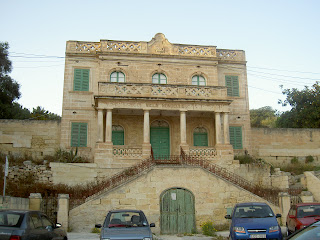
Apap Bologna Palace


As I was strolling along the promenade a couple of weeks ago I found this old abandoned building up a slope behind Brighton take-away. Looking at this derelict building I couldn't believe that it was so quiet up there, so secluded. Only two fighting cats broke the silence that reigned in that place. The garden with the overgrown shrubs and creepers next to the house reminded me of Estelle's house in Dicken's Great Expectations. I was almost expecting an old woman hobbling in the garden. Curiosity got the better of me and back home I did some research as to what this lovely building used to be before. It belonged to the nobles Apap Bologna, on whom the title of "Marquis of Gnien is-Sultan" was bestowed by Grand Master de Rohan in 1792. These were great benefactors of the parish of Marsaskala. In the year 1997 the Apap Bologna Palace together with the chapel, was donated to the Bishop's Curia to serve as a rest house for elderly priests. However, I got the impression that the building is no longer in use..Who knows maybe I'm wrong..

Tuesday, May 12, 2009

Marsascala police station


Coastal redoubts were one type of coastal defences built in the early 18th century. The most numerous types of fortifications of this period were the coastal batteries, which were generally built in vulnerable bays opposite each other and armed with cannons. On the other hand coastal redoubts were built in the middle of the bay in order not to let enemy forces disembark their troops ashore.

They operated as an infantry defensible stronghold to resist enemy troops. The idea of building this type of fortification was brilliant because if enemy soldiers were able to disembark their soldiers, they would overwhelm these fortifications quickly. The reason was because in the middle of the bay there was no fortification. But with the introduction of the coastal redoubt the situation was different because all the vulnerable points of the bay were defended by these coastal fortifications.

This redoubt is currently being used as a police station in Marsascala and is very close to the parish church. It is one of the best preserved redoubts in the Maltese islands. It was built in 1715 at the expense of 768 skudi by the Commendatore Gio.Battista Briconet and was initially garrisoned by local militia from the Zejtun Regiment. It consists of a pentagon-shaped fortification and entrance was from the side today facing a private building. A redan, ( a work in a V-shaped projecting angle) fitted with musketary loop-holes, was erected. Obviously such a small fortification was not meant to deter any potential landing, but to slow down an enemy's movements once on land.

Monday, May 4, 2009

Maltese balconies in Marsascala


The balconies are unequivocally an important feature of the Maltese streetscape. They are amongst the first characteristics of Malta you notice. In many ways, they are similar architecturally to those of the North African countries. In Gozo and in some older Maltese villages, you’ll see square stone balconies, often elaborately carved. The elegant wooden balconies of Valletta (the capital city of Malta) were used as a view point for families to catch up on the business of the streets below. Today in Valletta you will see baskets lowered from balconies for the baker to pop in a loaf of bread. This simple act saves the home owner several tortuous flight of stairs. The finest and longest balcony is that of the Grand Master’s palace in Valletta. It stretches around corners and along the side street walls.

It is believed that the first open balconies built entirely from stone began to appear locally during medieval times and that the first closed timber balcony appeared around 1679, when the corner balcony of the Grand Master’s Palace in Valletta was covered with a timber and glass structure joining all the rooms on this side of the Palace. During the 18th century the popularity of the closed timber balcony spread from Valletta to the villages where it became fashionable to replace the open balconies with an enclosed timber one.


Last Friday I woke up early and went for a drive round my lovely hometown. I took photos of some particular houses which caught my attention. These three houses with their different colour schemes look really lovely next to each other. Don't you agree?


I took photos of the above balconies because I think these Marsascala houses are pretty old. And their balconies are rather unusual. I have never encountered such balconies anywhere else in Malta.

Saturday, April 18, 2009

The Three Crosses


During one of my walks in my hometown of Marsascala I came across this strange monument in the Bidni area. It's got these three crosses engraved on a wall. The middle cross which is slightly larger than the other two has around what look like seven tools hanging from it. My question is who erected this memorial and for what reason? It's a pity that there is no date or inscription to explain why it was built in the first place.

Till 1615, Zabbar and Marsascala, were still forming part of the Zejtun parish. At that time a mere 650 people inhabited Zabbar. As was the practice, Bishop Cagliares established the limits of the young parish. As a matter of fact, a section of modern Marsascala remained within the limits of Zejtun, while another part which included the areas where the first parish church of Marsascala was built, fell within the limits of Zabbar. It is possible that the Three Crosses at Bidni were put up as an indication of the place where the limits of Zejtun and Zabbar met.
According to Guze Muscat Azzopardi there are three versions regarding the origin of these crosses. There were three monks who got killed by the Turks and buried here, the second version says that a man died of the plague and was buried here by the villagers of Zejtun and the last version is undoubtedly the least credible one: an elderly hermit was buried three times in this place after repeatedly rising from death.

Tuesday, April 7, 2009

Marsascala


This kind of spring weather makes me feel the urge to go out for walks and explore new paths in the countryside. To be honest, I do not walk much but when I do I really enjoy myself. I take my camera with me - always on the look out for old disused paths, something unusual, derelict buildings, or a beautiful scene. In one of my walks in Marsascala, I took some pictures which you will see in the coming posts.

Marsascala is a small picturesque sea-side village in South Eastern Malta that has grown up around Marsascala Bay. It also goes by the name of Wied il-Ghajn. In the past it used to be a fishing village but now it has been turned into a tourist resort. Marsascala is divided into different areas namely, Zonqor, Bidni, Siberia, Bellavista and St. Thomas area.
In summer Marsascala is buzzing with activity. Most of the people usually walk along the promenade that stretches all the way around the bay from Zonqor Point around to the ex-Jerma Palace Hotel, with stops on the way for drinks and snacks from the bars and restaurants nearby. These walks usually take place in the evenings as it's a lot cooler than during the day when its just too warm to contemplate walking, and the day is usually spent in and around the cafes and restaurants.